Introduction:
Missoula, Montana, is surrounded by a vast beauty, not just in distant scenery but right here within our city. This beauty has been marred in recent years by the tents, trash, and drug paraphernalia that cover our greenbelts and sidewalks due to the nearly 600 unhoused households within the city.
Figure 1: Building art adorns a downtown Missoula, MT, tackle shop. Recently, the streets of Missoula have been adorned with tents (Jason Laughlin 2024)
Many of these unhoused are in their situation due to drug abuse and mental health issues. Currently, our solution is to arrest the users, send them to prison, and then release them back to the same situation, possibly with a drug rehabilitation program to be completed. This solution has not helped enough.
Missoula has many programs designed to help get our unhoused off of the streets, and they do help many people. The problem, however, is that most all of these programs will not admit a person who has substance abuse issues. These people are forced to live in the local parks and on our sidewalks. In this environment, they fall prey to the countless drug dealers, many of them unhoused themselves, who roam the encampments.
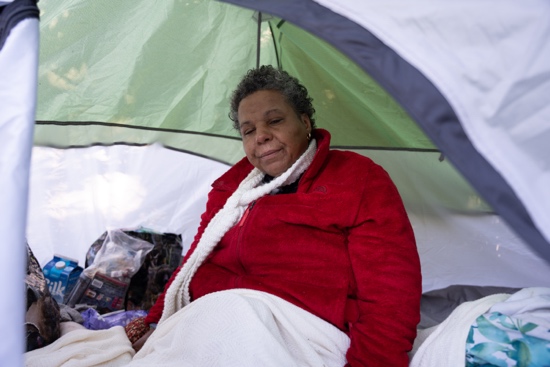
Figure 2: Mary, a member of the Missoula, MT, unhoused community, sits in her tent on a Fall morning. The unhoused situation in Missoula has been a hot topic in the community and a cause of much debate. (Jason Laughlin 2024)
Upon speaking with representatives from many of these charitable organizations, I have found that they feel their hands are tied. Missoula has passed many laws addressing the unhoused issue, including recent ordinances to reduce or prevent urban camping. Still, most of these initiatives seem to help the community and its housed residents instead of helping to get these people off of the streets. Most of these organizations’ representatives have expressed the same opinion: something needs to be done on the national level to address the drug problem before we can help many of these people.
The purpose of this report is to investigate how we, as a nation, can improve the unhoused crisis. Historically, we have arrested drug abusers, regardless of their living situation, and locked them up in jails and prisons. Upon release, they may have some drug classes that they are forced to attend, and they return right back to the same situation they were in before they got arrested, whether they choose to attend the mandated classes or not. Another solution would be that, instead of incarcerating individuals for drug abuse, we commit them. These individuals would be committed to in-house drug treatment programs, along with classes that teach them how to live their lives again.
This report will evaluate these two positions:
- Side A – We keep the laws the same
- Side B – We navigate civil rights laws and make changes that force the offenders to try for a better life; We commit.
The information included will be primarily based on statistics and predictions about financial responsibility for care and past recidivism rates for drug offenders, as well as a myriad of other proofs. Officially, this report will show that drug abuse should be classified as a mental health crisis and recommend a change in the current laws that allow abusers to continue these detrimental paths that affect every person living in the same communities as they do.
Overview of positions:
There are statistics and numbers everywhere you look about the war on drugs and homelessness, and there are also opinions on possible solutions. Since the war on drugs began on June 17, 1971, the United States has spent more than a trillion dollars fighting drug use. The federal government also allocates billions of dollars each year to programs that fight homelessness, yet the number of unhoused citizens continues to rise, as can be witnessed in any city across the US.
Many, such as Ilyana Kuziemko and Steven D. Levitt, who wrote “An Empirical Analysis of Imprisoning Drug Offenders,” feel that the system is working and we need to continue the status quo. Many people also feel that committing drug abusers to long-term treatment programs violates their civil rights and that we should continue to imprison them for breaking the law. Still, others can see the benefits of long-term solutions, such as the 35 states that have already passed laws allowing the commitment of drug offenders.
Side A: Status quo – We continue to incarcerate unhoused drug offenders:
With less than five percent of the world’s population but nearly 25 percent of its incarcerated population, the US imprisons more people than any other nation in the world, largely due to the war on drugs. (Drug Policy Alliance, 2015) In federal prisons alone, nearly 65 percent of inmates are there for drug offenses. This is a huge amount, but many feel that keeping them off of the streets is what’s important. Studies have shown that incarcerating drug offenders is found to be almost as effective in reducing violent and property crime as locking up other types of offenders. (Kuziemko & Levitt, 2004)
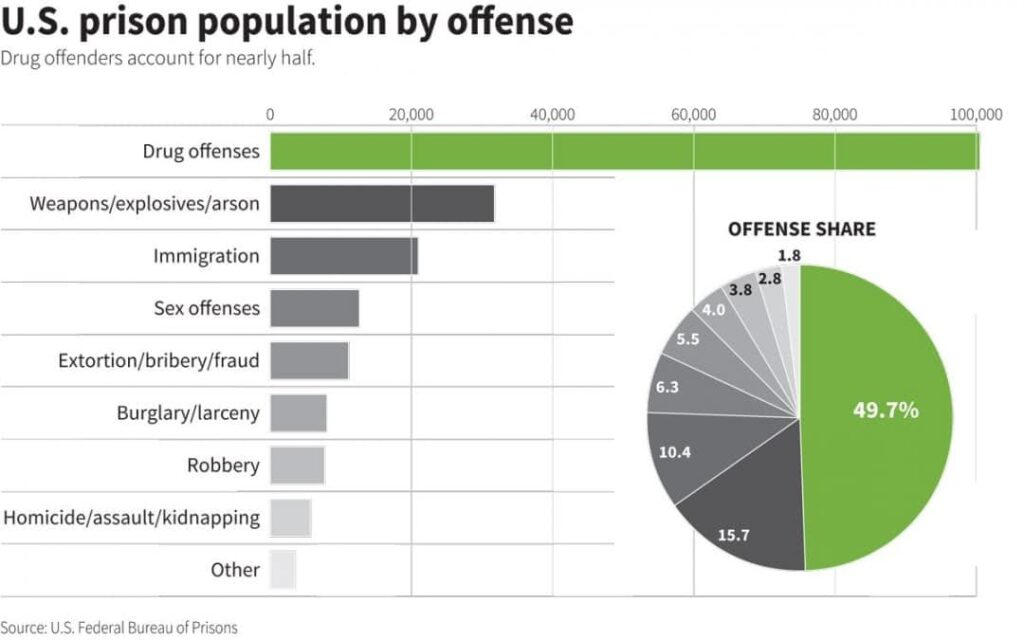
Figure 3: U.S. Prison population by offense (US Federal Bureau of Prisons 2022)
Through my research online and in simply engaging the local Missoula unhoused community, I have seen that drugs are not the primary cause of homelessness. Covid and the housing market have caused many to not be able to afford to live. Once on the streets, many of these people fall prey to drug dealers and lean on drugs as a means of comfort and escape from the harsh realities that they face. I spoke with a man that we’ll refer to as Mike, who lost his home during the Covid epidemic. Since then, he has not only found comfort in the drugs but began selling them to his companions. Mike expressed that selling fentanyl, or blues, has kept him fed but admits that it also keeps him and many of his community unhoused. While there are treatment programs available for drug and alcohol users, nearly all of the shelters within Missoula will not allow drug abusers or those who have been evicted from residences due to drug-related incidents. All information I’ve found tends to confirm this nationally.
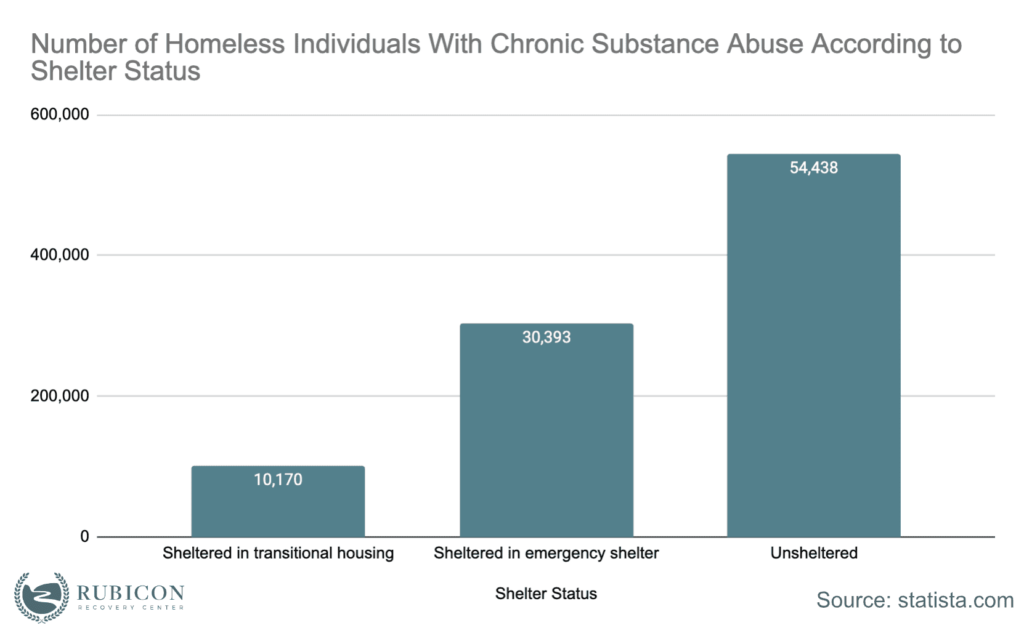
Figure 4: Number of homeless individuals with chronic substance abuse according to shelter status (Statista 2023)
With the current housing market, many people simply cannot afford to live. Analyses of rent prices and the number of unhoused in US cities have shown a definite correlation between the two, as urban areas with high rents also have an increase in the number of unhoused. The Pew Charitable Trusts compared homelessness and rent data in 2017 and 2022. In recent years, many metro areas in the U.S. have seen stark increases in levels of homelessness along with fast-rising rents. At the same time, some other locales that saw slow rent growth experienced declines in homelessness. (Horowitz et al., 2023)
There is also the issue of human rights. We, in America, are quite sincere about our rights, and anything that takes control out of our hands is bound to raise serious controversy. To commit drug abusers would be to take away their right to life, liberty, and security of person. The International Network of People who Use Drugs, or INPUD, states that “Though Article 9 of the UN’s International Covenant on Civil and Political Rights states that ‘No one shall be subjected to arbitrary arrest or detention,’ police are able to arrest and detain people who use drugs without following the same processes that many other citizens enjoy.” (International Network Of People Who Use Drugs, 2015)
Side B – We make changes that force the unhoused drug offenders to try for a better life; We commit.
We have already established that drug abuse is not the main cause of homelessness. The Covid epidemic and housing costs seem to be the primary culprits. According to the National Alliance to End Homelessness, “from 2019-2023, the number of people who entered emergency shelter for the first time increased more than 23 percent.” (Soucy et al., 2024) However, we have also established that many people turn to drugs after experiencing life on the streets. According to the Denver Rescue Mission, “Using substances to escape these high-stress situations only intensifies the very problems that are causing someone’s homeless experience to begin with, creating a vicious cycle that is extremely hard to break. And when each day is intensely focused on just finding food and shelter to survive, long-term recovery can simply become a low priority.” (Tromp, 2023)
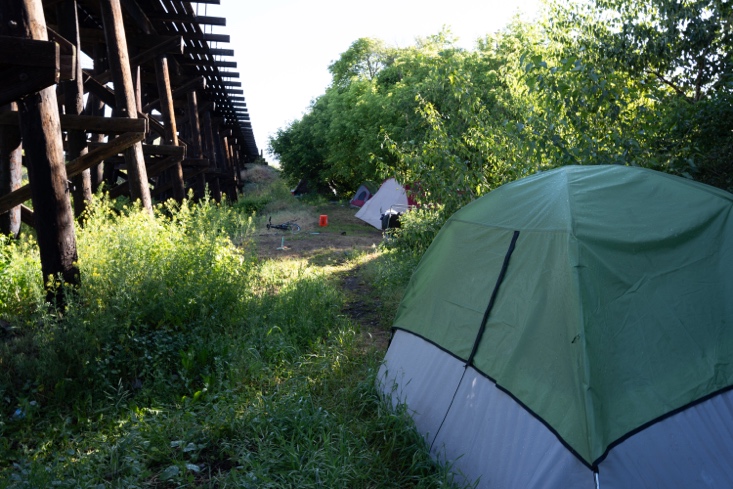
Figure 5: Tents line a greenbelt in Downtown Missoula, Montana. The Missoula unhoused community has grown substantially through the last three years (Jason Laughlin 2024)
Walking through the encampments and talking with people, I’ve been able to see firsthand the effects that substance abuse can have on the unhoused. Drug use is prevalent, but recovery seems to take a second seat to other daily priorities. Mary, who I spoke about previously, was primarily concerned with finding a place to do laundry until the aforementioned Mike showed up to give her some “blues.” When I went back three hours later, she was asleep in her tent. Mike himself expressed that many of those in his community would have already received the help they needed from the numerous Missoula resources that are available if they were not addicted to drugs.
According to OpenSocietyFoundations.org, “states and federal government continue to spend about $10 billion a year imprisoning drug offenders, and billions more on the ‘War on Drugs,’ and these costs do not include the impact incarceration has on the economic and social life of the country, individual states, and communities.” (Ziedenberg, 2003) With the amount of drug offenders in prison, this works out to about $33,000 per inmate per year. After they are released, there is usually a mandatory treatment program that they must attend, which averages about $4,000. (National Center for Drug Abuse Statistics, 2022) Recidivism for these offenders is between 30-50%, which means this money will be spent repeatedly for the same individuals. For 100 offenders, as an example, that equates to about $5,180,000. And that is with no real improvement to the quality of life for the offenders or those in the communities in which they live.
Addiction and substance misuse are major problems in the United States. However, a survey conducted by the Substance Abuse and Mental Health Services Administration (SAMHSA) found that more than 95% of people who needed drug rehab in 2023 didn’t receive it. (Manwarren Generes, 2023) I have walked the Missoula encampments and seen many of these people. I have also seen many who had mandated treatment programs that did not show up. When your priorities are to find food and shelter, and you have no physical address for the police to find you, would you bother?
With the discussion of committing drug abusers, you cannot escape the issue of basic human rights. America has a long history of committing people with mental health issues if they meet certain criteria. Mostly, it must be decided that they are a danger to themselves or others, that they are currently unable to make the right decision for themselves, and that a reasonable person would accept the treatment. How is it that chronic drug abuse does not fall into this category? According to the National Drug Intelligence Center, some common serious mental disorders associated with chronic drug abuse include schizophrenia, bipolar disorder, manic depression, attention deficit hyperactivity disorder, generalized anxiety disorder, obsessive-compulsive disorder, post-traumatic stress disorder, panic disorder, and antisocial personality disorder. (National Drug Intelligence Center, 2004) All of these conditions can be managed with proper care, which they are not receiving while living on the streets. The drugs also undoubtedly exacerbate these symptoms, making drug abuse a valid reason to commit.
Conclusion:
A common saying in the US is, “If it ain’t broke, don’t fix it.” Well, it’s broke. We are going on 50 years of the war on drugs and we’ve only seen things get worse. If you just look back to the turn of the century, overdose deaths have increased by five times. (National Institute on Drug Abuse, 2024)
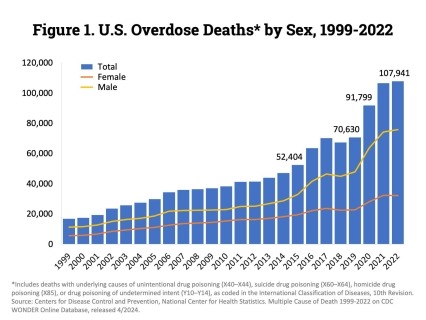
Figure 6 Statistics on drug overdose deaths in the last 25 years. (National Institute on Drug Abuse 2023)
Currently, 35 states and the District of Columbia have enacted involuntary commitment laws for those suffering from substance abuse disorders. (National Judicial Opioid Task Force, n.d.) (see Appendix A) These states have found that they have a moral obligation to help those who are unable to help themselves. According to the National Institute on Drug Abuse, treatment does not need to be voluntary to be effective. Studies show that sanctions such as involuntary commitment can significantly increase treatment entry and retention rates as well as the overall success of treatment interventions. (Involuntary Rehab: Can You Force Someone into Rehab? How?, 2024)
According to the Anti-Drug Abuse Act of 1988, Public Housing authorities must include in their lease provisions explicit rules that require eviction for drug possession. This goes on the public record and shows up when those same people request entry to a shelter in the future. At least here in Missoula, those individuals are not being permitted entry. This potentially leads to the hopeless feeling that leads them to future abuse.
Recommendation:
This report recommends that more states enact laws for the commitment of drug abusers and that all states take it seriously. Over these last 50 years of the War on Drugs, statistics have shown that mass incarceration and minimal treatment of drug abusers have not worked, costing the American taxpayers trillions of dollars in wasted money. It is time to find a plan that works. The police here in Missoula, according to interviews with the drug dealers and users living on our streets, have largely given up on arresting any of them and mostly leave them alone. This contributes to the crime and filth on our streets. The users continue to use, causing them to lack shelter and basic needs. This, itself, constitutes a danger to themselves and the general public. They are not making decisions that are in their best interest.
The federal government needs to enact laws enabling police to pick up these offenders, knowing that they will be sent somewhere that will actually help, instead of knowing that they will have to deal with the same problem down the road. I believe, once enacted, that we can restructure some of our overcrowded prisons. A few less locked doors and a more therapeutic setting will allow the offenders to spend a year there as a residential detox facility instead of prison. They need more mental health and substance abuse support and less correctional staff. If they graduate from there, they spend the next three years in a residential treatment facility (RTF).
These RTFs will continue the care while also teaching them the unused or forgotten skills of how to function at home and within society. These should take place in a dorm-type living structure with days full of individual and group therapy and chaperoned outings on the weekends but with a strict structure. These years could be extended by measuring progress at certain steps.
After those three years, graduates should be moved into special houses with other graduates for a period of one year. During that year, they will continue to attend regular individual and group therapies but will also receive support with finding education and employment. Transportation will be provided and the centers will act as fiduciaries, managing all pay that the participant makes, ensuring that money is being put into savings.
Once that year is finished and the graduates are ready, we, the people, will buy them a place to live. Many people will gripe about this, as there are millions of hard-working Americans who cannot afford to buy a house, but those same citizens will be happy to have safer communities. In my plan, the government will buy reasonably priced houses off the market, contributing to our economic growth at the same time. These houses will be owned by the government but occupied by the graduates of the program. If those individuals can remain drug-free and employed for five years, they will have the option to make payments toward the previous five years of property taxes in order to own the house.
We will never get the entire American public to agree on anything when it comes to enacting policy, but I think we can all agree that drug abuse and homelessness are a huge problem that is not only marring our landscapes but our idea that the American dream is still relevant. Something must be done, and the status quo is not it.
List of References:
Drug Policy Alliance. (2015a). The Drug War, Mass Incarceration and Race. In Drug Policy Alliance. United Nations Office on Drugs and Crime. https://www.unodc.org/documents/ungass2016/Contributions/Civil/DrugPolicyAlliance/DPA_Fact_Sheet_Drug_War_Mass_Incarceration_and_Race_June2015.pdf
Horowitz, A., Hatchett, C., & Staveski, A. (2023a, August 22). How Housing Costs Drive Levels of Homelessness. Pew. https://www.pewtrusts.org/en/research-and-analysis/articles/2023/08/22/how-housing-costs-drive-levels-of-homelessness
International Network Of People Who Use Drugs. (2015a). Violations of the Human Rights of People Who Use Drugs Drug User Peace Initiative Violations of the Human Rights of People Who Use Drugs. https://www.unodc.org/documents/ungass2016/Contributions/Civil/INPUD/DUPI-Violations_of_the_Human_Rights_of_People_Who_Use_Drugs-Web.pdf
Involuntary Rehab: Can You Force Someone Into Rehab? How? (2024a, May 23). Drug Rehab Options. https://rehabs.com/treatment/involuntary-rehab/
Kuziemko, I., & Levitt, S. D. (2004a). An empirical analysis of imprisoning drug offenders. Journal of Public Economics, 88(9-10), 2043–2066. https://doi.org/10.1016/s0047-2727(03)00020-3
Manwarren Generes, W. (2023a, July 12). Drug Rehab Success Rates and Statistics. American Addiction Centers. https://americanaddictioncenters.org/rehab-guide/success-rates-and-statistics
National Center for Drug Abuse Statistics. (2022a). Average Cost of Drug Rehab [2022]: by Type, State & More. NCDAS. https://drugabusestatistics.org/cost-of-rehab/
National Drug Intelligence Center. (2004a, April). Drug Abuse and Mental Illness Fast Facts. Www.justice.gov. https://www.justice.gov/archive/ndic/pubs7/7343/index.htm
National Institute on Drug Abuse. (2024a, August 21). Drug Overdose Deaths: Facts and Figures | National Institute on Drug Abuse. National Institute on Drug Abuse. https://nida.nih.gov/research-topics/trends-statistics/overdose-death-rates#Fig1
National Judicial Opioid Task Force. (n.d.-a). Involuntary Commitment and Guardianship Laws for Persons with a Substance AUse Disorder . Retrieved November 5, 2024, from chrome-extension://efaidnbmnnnibpcajpcglclefindmkaj/https://www.ncsc.org/__data/assets/pdf_file/0028/18478/inv-comm-and-guard-laws-for-sud-final.pdf
Soucy, D., Janes, M., & Hall, A. (2024a). State of Homelessness: 2024 Edition. National Alliance to End Homelessness. https://endhomelessness.org/homelessness-in-america/homelessness-statistics/state-of-homelessness/
Tromp, E. (2023a, October 24). The Connection Between Homelessness and Substance Abuse: How the Mission Helps. Denver Rescue Mission. https://denverrescuemission.org/homelessness-and-substance-abuse/
Ziedenberg, J. (2003a, October). Costs and Benefits? The Impact of Drug Imprisonment in New Jersey. Www.opensocietyfoundations.org. https://www.opensocietyfoundations.org/publications/costs-and-benefits-impact-drug-imprisonment-new-jersey

Leave a Reply